Kathmandu, Pokhara & Chitwan with Bandipur: Nepal’s Ultimate Golden Triangle Journey
For most people, the mere mention of Nepal conjures up images of towering, snow-capped peaks and mountaineers braving extreme altitudes. But if you only look at the map from the snow line up, you miss out on the real heartbeat of the country. Tucked between the high Himalayas and the southern plains is a vibrant world of medieval towns, emerald lakes, dense jungles, and ancient cultures that many travelers fly right over.
If you want to experience the true soul of Nepal in one seamless loop, the classic route hitting Kathmandu, Pokhara, and Chitwan National Park forms the definitive Nepal Golden Triangle. But if you want to turn a great trip into an unforgettable one, you add Bandipur—a beautifully preserved hilltop outpost that feels like stepping into a living museum.
Whether you are putting together a comprehensive Nepal tour, planning an extended Multiple day tour in nepal, or looking for the perfect cultural loop to tackle before heading off on a major trek, this guide breaks down everything you need to know for the ultimate road trip.
The Route at a Glance
This loop connects four distinct regions, each showcasing a completely different side of Nepal’s geography, culture, and daily life.
| Destination | The Vibe | The Big Highlight | How Long to Stay |
|---|---|---|---|
| Kathmandu Valley | Bustling, ancient, and spiritual | UNESCO world heritage & medieval squares | 2–3 Days |
| Bandipur | Quiet, historic, and romantic | Preserved Newari architecture & ridge views | 1–2 Days |
| Pokhara | Relaxed, scenic, and adventurous | Annapurna reflections & lakeside cafes | 3 Days |
| Chitwan | Wild, humid, and untamed | Deep jungle safaris & wildlife tracking | 2–3 Days |
Kathmandu – The Living Museum of Heritage
Your journey kicks off in the Kathmandu Valley. Sitting at about 1,400 meters, this elevated basin is a chaotic, beautiful crossroads where Hinduism and Buddhism have grown side by side for over two thousand years.
Walking Through the Three Durbar Squares
The artistic soul of the valley is split among three historic kingdoms: Kathmandu, Patan, and Bhaktapur. Each city centers around its own Durbar Square (royal palace plaza), packed with multi-tiered wooden pagodas, stone carvings, and massive brass bells.
-
Kathmandu Durbar Square: The ancient home of the Malla kings and the current residence of the Kumari—the world’s only living goddess. If your timing is right, you might catch a glimpse of her at the intricately carved wooden windows of her courtyard residence.
-
Patan Durbar Square: Just across the river, Patan is the artistic capital, famous for its metalwork. Don't miss the Krishna Mandir, a stunning temple built entirely of stone with detailed friezes telling stories from the Mahabharata epic.
-
Bhaktapur Durbar Square: This medieval city has banned cars from its historic core, making it a dream to explore on foot. Walk past the 55-Window Palace and marvel at the Nyatapola Temple, a five-tiered architectural masterpiece that has stood strong through major earthquakes for over three centuries.
The Sacred Landmarks: Swayambhunath, Boudhanath, and Pashupatinath
Beyond the royal palaces, Kathmandu’s spiritual centers are what truly ground the city.
Perched on a hill to the west is Swayambhunath Stupa (fondly called the Monkey Temple). Here, the all-seeing eyes of the Buddha watch over the valley from a gilded spire, while playful rhesus macaques dart between ancient stone shrines.
On the eastern side of town lies Boudhanath Stupa, one of the largest spherical stupas in the world. It’s the focal point for Nepal’s Tibetan Buddhist community. If you visit at dusk, you’ll join thousands of locals walking the clockwise kora (ritual circumambulation) around the massive white dome, listening to the hum of Tibetan horns and breathing in the scent of burning juniper.
A short drive away on the banks of the sacred Bagmati River sits Pashupatinath Temple, the holiest Hindu shrine in the country. While the main golden temple is open only to practicing Hindus, travelers can observe the spiritual open-air cremation rituals from across the river—a powerful, humbling window into Hindu cycles of life and death.
Pro Tip: To really appreciate the scale of the Himalayas before hitting the road, look into an early morning Mountain flight from Kathmandu. It gets you eye-level with Mount Everest (8,848.86 m) without any of the physical exhaustion.
Bandipur – The Queen of the Hills
Leaving the capital behind, you’ll drive west down the winding Prithvi Highway, tracing the path of the fast-flowing Trishuli River. Midway to Pokhara, near the junction town of Dumre, a steep switchback road climbs up into the hills. This brings you to Bandipur, a beautifully preserved hilltop village sitting at 1,030 meters.
A Time Capsule of Newari Culture
Back in the 18th and 19th centuries, Bandipur was a thriving trading post on the commercial highway connecting Tibet with India. Newar merchants from Kathmandu settled here, building grand, multi-story brick homes with beautifully carved wooden shutters and classic slate roofs.
When the modern highway was built down in the valley during the mid-20th century, it completely bypassed the town. While that initially hurt the local economy, it turned out to be a massive blessing for preservation. Instead of being torn down for modern concrete structures, Bandipur’s architectural heritage remained frozen in time.
Today, the main bazaar is completely pedestrianized. It feels less like a tourist trap and more like an open-air historical museum lined with boutique guesthouses, cozy cafes, and bright bougainvillea.
Sunrise Views and Underground Adventures
Bandipur sits on a narrow mountain ridge that drops steeply away into deep green valleys on both sides, making it a paradise for easy day walks.
-
The Thani Mai Temple Climb: A 30-minute uphill walk on a stone staircase leads to a small ridge-top shrine. Get up here before dawn; you’ll see the entire town of Bandipur blanketed in morning mist below, while the jagged white wall of the Annapurna Range, Manaslu, and Ganesh Himal lights up in gold.
-
The Tundikhel Plateau: A massive, flat, man-made plateau that once served as a staging ground for trade caravans. Today, it’s a scenic park where locals gather to chat and watch the sunset.
-
Siddha Gupha (Siddha Cave): If you are up for an adventure, a rugged trail through the forest leads down to one of the largest limestone caves on the subcontinent. Exploring its massive chambers requires a local guide and a headlamp to safely navigate the stalactites and the resident bat colonies.
Pokhara – Lakes, Peaks, and Extreme Adventure
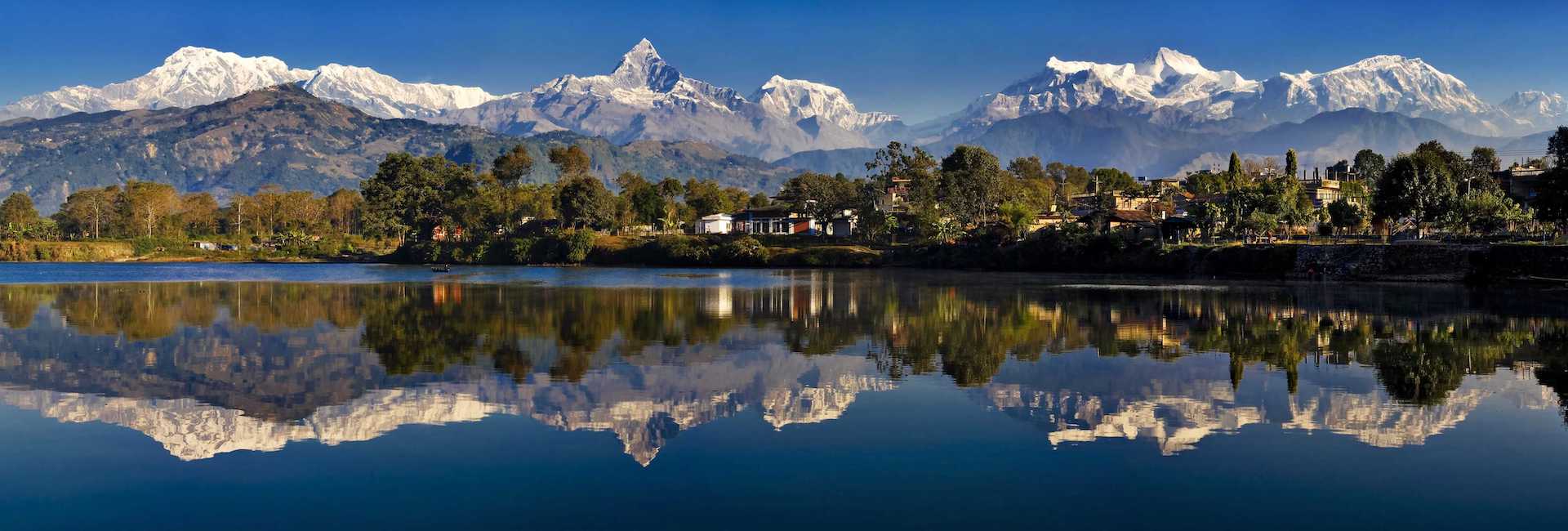
Descending from Bandipur, the journey continues west toward Pokhara, Nepal’s ultimate outdoor playground. Sitting at an altitude of 822 meters, Pokhara is a scenic valley dominated by the dramatic, unclimbed peak of Machhapuchhre (the iconic "Fishtail Mountain," 6,993 m), which reflects perfectly in the waters of Phewa Lake.
Lakeside Living and Island Temples
Life here centers around Baidam, known simply as Lakeside. This vibrant strip of shoreline is packed with artisanal bakeries, trekking gear shops, and open-air bars.
Rent a traditional brightly painted wooden boat (doonga) and paddle out to Tal Barahi Temple, a two-tiered pagoda shrine sitting on a small island in the middle of the lake. On a clear afternoon, the water turns into a perfect mirror, reflecting the white pyramid of Machhapuchhre.
For the best views of the valley, make sure to visit:
-
The World Peace Pagoda (Shanti Stupa): Perched on a ridge across the lake, this brilliant white monument was built by Japanese monks to promote global peace. It offers sweeping 360-degree views of the lake and the high mountains.
-
Sarangkot Hill: Rising to 1,592 meters on the northern edge of the valley, Sarangkot is the place to be for sunrise. Travelers head up in the dark to watch the morning light paint the Annapurna range in shades of brilliant orange.
The Adventure Capital
If Kathmandu is the cultural anchor of your trip, Pokhara is the pure adrenaline rush. The thermal updrafts rising from the valley floor make Sarangkot one of the top paragliding spots in the world. Tandem flights allow you to share the sky with black kites and eagles while taking in birds-eye views of the lakes and snowfields below.
Pokhara is also the gateway for world-class trekking in Nepal. From the edge of the valley, trails lead right into the Annapurna Conservation Area, heading toward legendary routes like Annapurna Base Camp or the Mardi Himal trail. Even if you aren't doing a multi-week trek, a short day hike through the rural Gurung villages of Dhampus or Astam gives you a great taste of traditional mountain life.
Chitwan – Into the Subtropical Wild
After exploring the mountain vistas of Pokhara, the route takes a dramatic turn. Heading south, the highway drops quickly out of the mountains and down into the Terai—the low-lying, humid southern plains of Nepal that run along the border with India.
Your destination is Chitwan National Park, a massive UNESCO World Heritage site covering 952 square kilometers of thick sal forests, marshy swamps, and tall elephant grass. This environment could not be more different from the mountains of Pokhara, proving that Nepal is much more than just snow and ice.
Tracking Rhinos and Bengal Tigers
Chitwan is celebrated as one of the greatest wildlife conservation success stories in Asia, serving as a vital sanctuary for the endangered Greater One-Horned Rhinoceros and the elusive Royal Bengal Tiger.
There are a few ways to get out and find them:
-
Open-Top Jeep Safaris: A deep-jungle Jungle safari takes you along dirt tracks into the heart of the park, giving you the best chance to spot wild elephants, sloth bears, leopards, and deer.
-
Dugout Canoe Rides: Gliding quietly down the misty Rapti River in a hand-carved wooden canoe brings you eye-to-eye with the park's aquatic life. You’ll spot rare, fish-eating Gharial crocodiles with their long, thin snouts, alongside Marsh Muggers basking on the banks.
-
Guided Jungle Walks: For a real thrill, exploring the wilderness on foot with two experienced local nature guides allows you to track paw prints, listen for monkey alarm calls, and experience the raw jungle up close.
Tharu Culture and Local Hospitality
The human history of Chitwan is deeply tied to the indigenous Tharu people, who have lived in these dense forests for generations.
Visiting a traditional Tharu village reveals homes built of mud, clay, and reeds, naturally insulated against the intense summer heat of the plains. In the evening, the local community gathers at cultural centers to perform the high-energy Tharu Stick Dance—a traditional display that started as a way to keep wild animals away from the village borders.
Practical Logistics: Connecting the Triangle
Getting around Nepal requires a bit of planning due to the winding terrain and varying road conditions.
Choosing Your Mode of Transport
-
Private Vehicle (Highly Recommended): Hiring an air-conditioned jeep or car with a local driver gives you total flexibility. You can stop for photos along the river gorges whenever you want, and they’ll drop you off right at your hotel in hilltop Bandipur.
-
Tourist Buses: Safe, comfortable, and affordable tourist coaches run daily between Kathmandu, Pokhara, and Chitwan. If you take this option for Bandipur, the bus drops you off at the highway town of Dumre, where you can easily catch a local jeep for the short climb up the ridge.
-
Domestic Flights: If you are short on time, you can skip hours of driving by taking a quick 25-minute flight from Kathmandu to Pokhara, or from Chitwan back to Kathmandu. Just keep in mind that flying means you’ll miss out on the overland stop at Bandipur.
When to Go
-
Autumn (October to November): The peak season. The monsoon rains have washed away the dust, leaving crisp, crystal-clear skies for spectacular mountain views in Kathmandu, Bandipur, and Pokhara.
-
Spring (March to April): A gorgeous season with warm weather and blooming wildflowers. The hillsides light up with pink and red rhododendron forests, and in Chitwan, this is the best time for wildlife viewing because the tall elephant grass is cut down by locals, making it much easier to spot rhinos.
-
Winter (December to February): Days are usually sunny and pleasant, though temperatures drop significantly at night. While morning fog can occasionally cause flight delays, the popular tourist hubs are much quieter and less crowded.
Frequently Asked Questions (FAQs)
1. How many days do I need for this entire loop?
To experience all four places without feeling completely rushed, a 9 to 11-day itinerary is ideal. This gives you 2 days for Kathmandu, 1-2 days to unwind in Bandipur, 3 days for the adventure and lakeside vibes in Pokhara, and 2-3 days for deep jungle safaris in Chitwan before making the trip back to the capital.
2. Is this route suitable for families or older travelers?
Absolutely. Unlike high-altitude mountain treks, the entire Golden Triangle route stays below 1,600 meters, meaning altitude sickness is never an issue. The activities can easily be tailored to any pace—whether you want relaxed lakeside strolls and gentle boat rides or extreme paragliding and jungle hikes.
3. Do I need to get special permits for these areas?
You don't need special trekking permits for regular city sightseeing. However, you will pay standard entry fees at historic sites like Bhaktapur and Boudhanath. Entering Chitwan National Park requires a park permit, which is almost always organized and included automatically by your jungle lodge or tour operator.
4. What is the internet and electricity situation like?
The infrastructure along this specific route is modern and reliable. Free high-speed Wi-Fi is standard in almost every hotel, cafe, and restaurant in Kathmandu, Pokhara, Bandipur, and Chitwan. Minor power drops can happen, but tourist hotels use solar backups or generators to keep the lights and Wi-Fi running.
5. What kind of clothes should I pack?
Because this trip takes you from cool mountain hill stations down to hot subtropical plains, layers are key. Bring lightweight, breathable, neutral-colored clothing for the jungle safaris in Chitwan (bright colors can startle the animals). For Pokhara and Bandipur, pack comfortable walking shoes and a warm fleece or light jacket for those chilly early-morning sunrises.
The Complete Spirit of Nepal
The real magic of the Golden Triangle with Bandipur lies in its sheer variety. Over the course of a single road trip, you step away from the ancient brick courtyards of medieval kings, walk down the tranquil, flower-lined streets of an old trading town, sail across a mountain lake, and track rhinos through the morning mist.
It’s a route that doesn’t just show you one slice of the country. It weaves together history, nature, adventure, and wildlife into one incredible story—making it the ultimate introduction to the magic of Nepal.