Culture, Permits, and the Path to Happiness
In a world that often feels like it's spinning too fast, the Kingdom of Bhutan remains a steadfast anchor of tradition, spirituality, and environmental sanity. Nestled in the folds of the eastern Himalayas, this tiny nation—roughly the size of Switzerland—has achieved what most modern superpowers only dream of: it is the world’s only carbon-negative country, and it measures its success not by the cold arithmetic of Gross Domestic Product (GDP), but by the warmth of Gross National Happiness (GNH).
As we move through 2026, Bhutan is undergoing a fascinating evolution. While it remains deeply rooted in its 7th-century Buddhist foundations, it is also looking toward a future defined by "Mindfulness City" projects and high-tech sustainability. Whether you are a high-altitude trekker, a spiritual seeker, or a culture enthusiast, Bhutan offers a journey that is as much internal as it is external.
1. The 2026 Permit & Visa Landscape: "High Value, Low Volume"
The first thing every traveler must understand about Bhutan is that it is not a "budget" destination by design. The kingdom employs a unique tourism policy to prevent the "over-tourism" seen in neighboring regions. You are not just a tourist here; you are a guest of the state, contributing directly to the nation's welfare.
The Sustainable Development Fee (SDF)
In 2026, the SDF remains the core of the Bhutanese travel experience. Following a significant policy shift in late 2023, the government introduced an incentive rate that is currently active through August 31, 2027.
-
International Travelers: The fee is $100 USD per person, per night. This is a 50% reduction from the original $200 rate, designed to revitalize tourism post-pandemic.
-
Indian Nationals: Due to special bilateral ties, travelers with an Indian passport or Voter ID pay ₹1,200 INR per person, per night.
-
Children: Those aged between 6 and 12 receive a 50% discount on the SDF, while children under 6 are exempt from the daily fee.
Where does your money go? The SDF is not just a tax. It directly funds free healthcare for all Bhutanese citizens, free education, the maintenance of mountain trails, and the national carbon-sequestration projects that keep Bhutan's forests absorbing more CO2 than the country produces.
Visa Procedures for 2026
While Bhutan has modernized its visa process, most travelers still find it most efficient to work through a licensed Bhutanese tour operator.
-
Direct Application: You can apply for a visa online via the Department of Immigration portal, but you must provide proof of your SDF payment and a confirmed itinerary.
-
The Visa Fee: There is a one-time processing fee of $40 USD.
-
Mandatory Guide: In 2026, it is still mandatory for international travelers to have a licensed guide for any travel outside the primary hubs of Thimphu and Paro. This ensures you don't accidentally wander into sacred "restricted" peaks or sensitive border zones.
2. The Cultural Fabric: Living the GNH
To understand Bhutan, you must understand Vajrayana Buddhism. It is not just a religion here; it is the oxygen. It dictates the architecture, the laws, the art, and the very cadence of daily life.
The Four Pillars of Happiness
Gross National Happiness is built on four pillars that you will see in action throughout your 7-day journey:
-
Sustainable Socio-economic Development: You’ll notice an absence of "big box" international chains. No Starbucks, no McDonald's. Local business is king.
-
Environmental Conservation: The constitution mandates that 60% of the land remains forested. In reality, it’s closer to 72%.
-
Preservation of Culture: Every building, even the new ones in Thimphu, must adhere to traditional architectural styles, featuring tiered roofs and hand-painted cornices.
-
Good Governance: Bhutan transitioned from an absolute monarchy to a constitutional monarchy in 2008, a move initiated by the Fourth King himself to ensure the people had a voice.
The "Divine Madman" and the Power of the Phallus
One of the most surprising cultural elements for first-time visitors is the prevalence of phallic imagery painted on houses or carved from wood. This stems from the 15th-century saint Drukpa Kunley, known as the "Divine Madman."
He used "crazy wisdom" to subvert the stuffy religious establishment of his time, famously using his "thunderbolt" to subdue demons. Today, these symbols are not viewed as lewd, but as protection against evil and symbols of fertility. Embracing this quirk is part of the authentic Bhutanese experience.
3. Gastronomy: The Chili as a Vegetable
In most cultures, chilies are a condiment. In Bhutan, they are the main course. If you enjoy spice, you are in heaven. If you don't, you'll need to learn the phrase "Nga-gi khey-re ma-tshey" (I don't eat spice).
-
Ema Datshi: The national dish. A potent mix of large green or red chilies sautéed with local yak or cow cheese.
-
Kewa Datshi: A milder version made with potatoes and cheese—a traveler favorite.
-
Red Rice: The only rice that grows at high altitudes. It has a nutty flavor and a firm texture, perfect for soaking up spicy gravies.
-
Suja (Butter Tea): A salty, buttery tea that is surprisingly comforting in the cold Himalayan mornings. It tastes more like a light soup than a traditional tea.
4. 2026 Festival Calendar: The Spectacle of the Tshechu
The Tshechu is a religious festival held on the tenth day of a month of the lunar calendar. It is a time for the community to gather, dressed in their finest Ghos and Kiras, to witness masked dances (Cham) that are believed to confer blessings on the viewers.
5. Unique Experiences You Can't Miss in 2026
The Gelephu Mindfulness City (GMC)
By 2026, the Gelephu Mindfulness City project in southern Bhutan will be a major point of interest. This "Special Administrative Region" is designed to be a hub for conscious business and sustainable tech, featuring architecture that blends seamlessly with nature. It represents the "New Bhutan."
Traditional Hot Stone Baths (Dotsho)
Forget the porcelain tubs of the West. A Bhutanese hot stone bath involves a wooden tub filled with water and medicinal herbs. In a separate compartment, river stones heated in a fire until they are glowing red are dropped into the water. The stones crack and sizzle, releasing minerals that are said to cure everything from arthritis to skin conditions.
The Dha (Archery) Experience
Archery is the national sport, but it’s played with a social fervor that rivals a World Cup final. The distance is 145 meters—so far you can barely see the target. When someone hits a bullseye, the team breaks into a synchronized dance and song. When someone misses, the opponents engage in good-natured, witty verbal abuse.
6. The "Heart of the Dragon" 7-Day Itinerary (2026)
This itinerary is designed for the modern traveler who wants a mix of iconic landmarks, physical adventure, and deep cultural immersion.
Day 1: The Descent into Paro & The Capital
-
The Landing: Your flight into Paro is one of the most scenic in the world, skimming past Mt. Everest and Lhotse.
-
Thimphu Transition: Upon landing, drive 1.5 hours to Thimphu.
-
Afternoon: Visit the National Memorial Chorten, where elderly locals spend their days spinning prayer wheels.
-
Evening: Walk the Norzin Lam, Thimphu’s main street. Check out the craft bazaar for authentic hand-woven silks.
Day 2: Thimphu – Ancient Meets Modern
-
Morning: Visit the Buddha Dordenma (Buddha Point). Standing 51.5 meters tall, it houses 125,000 smaller statues. The view of the valley from here is unparalleled.
-
Lunch: Try a traditional "tiffin" lunch at a local cafe.
-
Afternoon: Visit the National Library to see the world's largest published book, and the Zorig Chusum, where students are trained in the 13 traditional arts of Bhutan.
-
Evening: A visit to the Tashichho Dzong, a fortress that serves as the summer capital and seat of the government.
Day 3: Over the Clouds to Punakha
-
Morning: Drive to Dochula Pass (3,100m). Stop for tea and admire the 108 memorial chortens. On clear days, you can see the entire Himalayan range.
-
Descent: Head down into the sub-tropical Punakha Valley.
-
Afternoon: Hike through rice paddies to Chimi Lhakhang, the temple of the "Divine Madman."
-
Evening: Stay at a riverside lodge and enjoy the warmer Punakha air.
Day 4: The Most Beautiful Fortress
-
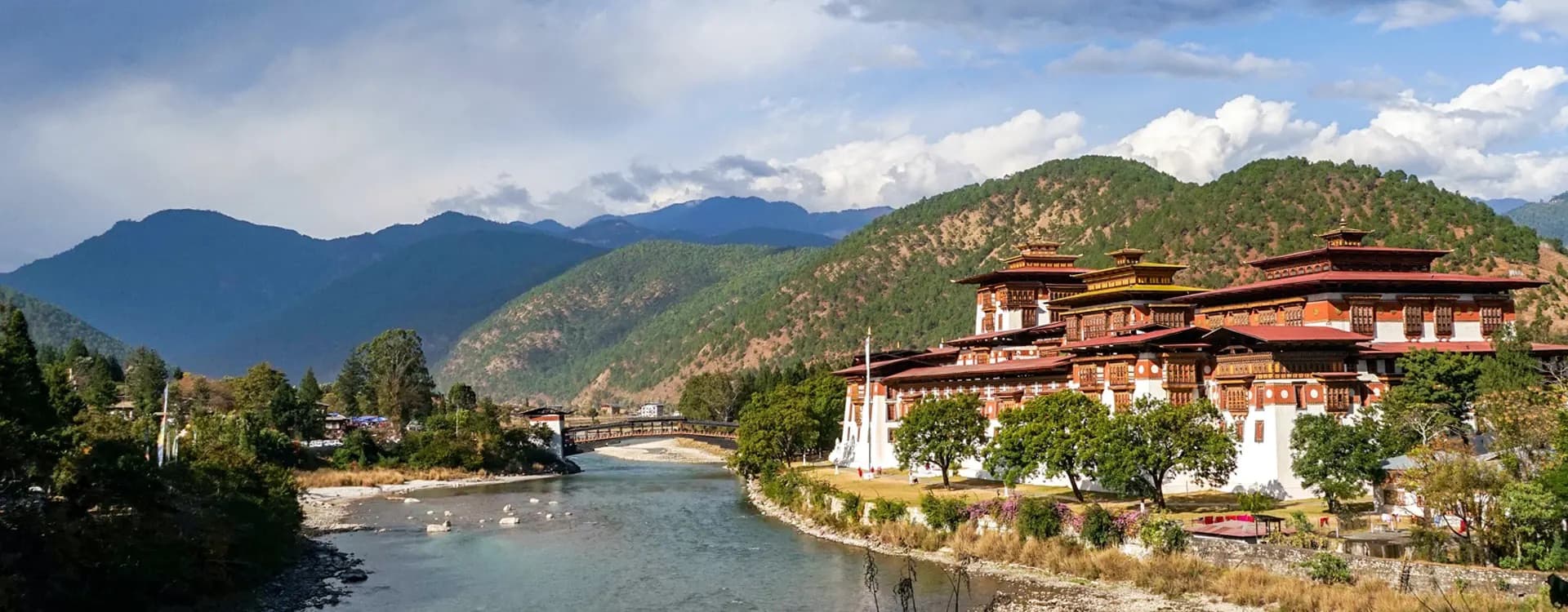
Morning: Explore the Punakha Dzong. Built in 1637, it sits at the confluence of the Pho Chhu (Father) and Mo Chhu (Mother) rivers. In the spring, the jacaranda trees turn the surrounding area purple.
-
Afternoon: Cross the Punakha Suspension Bridge, one of the longest in the country, and hike up to the Khamsum Yulley Namgyal Chorten for a view of the terraced fields below.
-
Evening: Traditional dinner with a local family in a farmhouse.
Day 5: The Glacial Valley of Phobjikha
-
The Journey: A 3-hour drive takes you into the wide, U-shaped glacial valley of Phobjikha.
-
Experience: Visit the Gangtey Monastery, a stunning example of Nyingma Buddhism.
-
The Hike: Walk the Gangtey Nature Trail (approx. 2 hours). It’s flat, serene, and passes through crane nesting grounds.
-
Evening: A quiet night in a valley where electricity was only introduced recently to protect the bird migrations.
Day 6: Return to Paro & Cultural Immersion
-
Morning: Drive back to Paro, stopping at Simtokha Dzong, the oldest fortress in Bhutan.
-
Afternoon: Visit Kyichu Lhakhang, one of the 108 temples built in a single day by the Tibetan King Songtsen Gampo in the 7th century.
-
Unique Activity: Try your hand at an archery lesson at your hotel or a local range.
Day 7: The Grand Finale – Tiger’s Nest
-
The Hike: Save the best for last. Paro Taktsang (Tiger’s Nest) clings to a cliff 900m above the valley floor.
-
Timing: Start at 7:00 AM. The hike takes about 2 hours to reach the cafeteria and another hour to reach the monastery.
-
Inside the Temple: Leave your shoes and phone at the gate. The silence inside the "Cave of Pelphug" is transformative.
-
Final Evening: A Hot Stone Bath to soothe your legs and a farewell dinner with your guide.
7. Practicalities & Packing for 2026
-
Money: The Ngultrum (Nu) is tied to the Indian Rupee. ATMs are common in Thimphu and Paro, but "cash is king" in the valleys. Visa and Mastercard are increasingly accepted in 4 and 5-star hotels.
-
Altitude: You will mostly be between 2,200m and 3,100m. Drink twice as much water as you think you need.
-
Connectivity: 4G is widespread, but 5G is rolling out in Thimphu in 2026. Buy a local SIM for about $10 at the airport.
-
Clothing: Dress like an onion—layers are vital. Even in summer, the wind on the passes can be biting. For temples, you must have long sleeves and long trousers.
Final Thoughts: The Cost of a Soulful Journey
Bhutan is not a place you "do"; it’s a place you feel. The $100 daily fee might seem high, but when you see the lack of plastic waste, the pristine rivers, and the genuine smiles of a people who feel protected by their government and their gods, the value becomes clear.
In 2026, Bhutan remains the gold standard for how a country can modernize without losing its identity. It is a reminder that happiness isn't a destination, but a way of traveling.